We study the function and regulation of the eukaryotic microtubule cytoskeleton, using the fission yeast Schizosaccharomyces pombe as a model system.
Microtubule nucleation in eukaryotic cells depends on a large protein complex that includes the protein γ-tubulin. Two fission yeast proteins, Mto1 and Mto2, form a complex (Mto1/2 complex) that is dynamically targeted to different cytoplasmic sites during the cell cycle and regulate cytoplasmic microtubule nucleation by recruiting the γ-tubulin complex to intracellular microtubule organizing centres. Mutations in the human homolog of Mto1 lead to the brain disease microcephaly. Our recent work has begun to identify the nature of the interaction between Mto1/2 and the γ-tubulin complex, and how the Mto1/2 complex is localized to different subcellular sites. Current challenges include determining the macromolecular nature of the Mto1/2 complex, and how it is assembled.
We have also identified and characterized additional novel components of the fission yeast γ-tubulin complex itself. Using microscopy and biochemistry approaches we have been able to show that in vivo, the fission yeast γ-tubulin complex appears to be very similar to the mammalian complex in terms of it constituent molecules and its behavior, and we have recently obtained evidence that the fission yeast γ-tubulin complex can bind to the ends of microtubules in vivo independent of its microtubulenucleating ability.
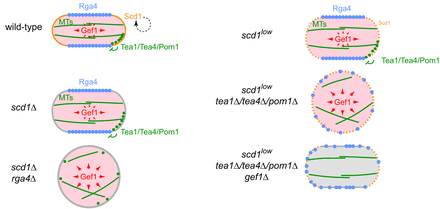
A separate project in the laboratory involves studying the establishment of cell growth polarity in fission yeast via the microtubule-mediated transport of the protein Tea1 to cell tips. This depends on interaction of Tea1 with at least two additional proteins, Tea3 and Mod5. Mod5 is a membrane-associated protein that anchors Tea1 at the cell cortex and also independently keeps Tea3 associated with the cortex. We have uncovered complex feedback mechanisms by which these three proteins regulate each other’s localization. We are unravelling the mechanisms of this using site-directed mutagenesis, protein biochemistry and proteomics, and protein dynamics microscopy.